From the cutting edges that carve through hard rock to the turbines, satellites and microelectronics that underpin the modern economy, tungsten and tungsten carbides have become some of industry’s quiet enablers. Their ideal combination of density, durability, and heat resistance makes them attractive materials when equipment must perform under extreme conditions.
Yet for all its importance, tungsten occupies an increasingly uncertain position in global supply chains: demand outpaces the supply chain. As demand continues to accelerate across energy, defence, aerospace, and advanced manufacturing—all priority economic sectors identified in the Alberta Technology and Innovation Strategy 2.0—concerns about long-term availability are prompting a new wave of research into substitute materials.
“Everyone wants solutions now,” says Patrick Flood, an Engineer with InnoTech Alberta and the MARIOS Consortium. “It’s not something that can wait five years. It’s something where we need to press every button we can find.”
An International Collaboration
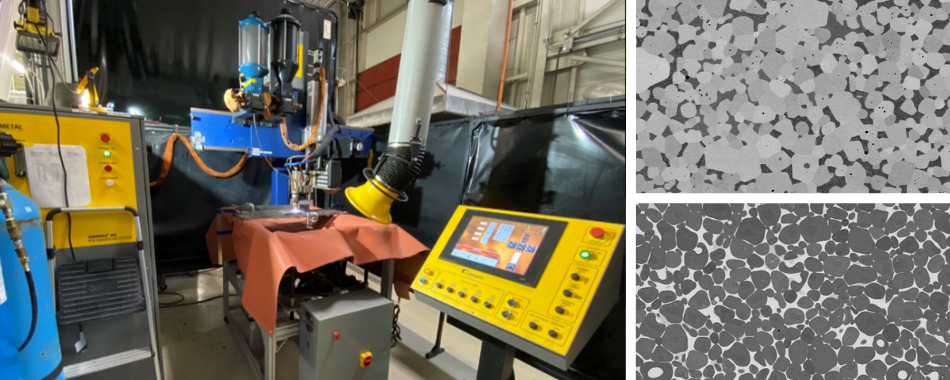
Flood is leading an InnoTech Alberta team that is working on two projects evaluating composites with potential to replace tungsten in industrial applications.
The first project is a collaboration with the Fraunhofer Institute, a German applied research facility with ongoing work to identify potential tungsten alternatives in ceramic-metal composites known as cermets. Flood and his team have been assessing materials developed by Fraunhofer to gauge their suitability for mining applications.
“We specialize in performance testing, specifically because we serve heavy industry in Alberta,” Flood says. “Over the years, we’ve developed different lab scale tests to evaluate wear performance under controlled conditions.”
Fraunhofer recently presented the findings of this work at the WorldPM2026 Conference, the largest powder metallurgy conference in North America, with positive reception.
Reaching Beyond the Lab
InnoTech Alberta is leading a second project within the MARIOS Consortium. Whereas the Fraunhofer project examines tools made entirely of the alternative carbide materials, this project considers the durability of tools coated in wear-resistant overlays. Because of MARIOS’ industry connections, Flood explains that promising prototypes move from lab testing to small-scale pilots through partner manufacturers.
“Once we can show with confidence that performance is comparable, that’s where we start working with the mining companies to do field trials,” he says. “Lab-scale is a good first step but, most of the time, companies want to use in their real applications to build confidence.”
If successful, this work has the potential to boost the productivity of the mining industry by connecting equipment manufacturers and supply companies to tungsten-equitable materials that meet consumer needs. Flood notes that while he is focused on mining, the benefits will extend to other industries that face challenges, such as aerospace, defence, and machining.
As demand for tungsten continues to accelerate, the pressure to find viable alternatives will only intensify. With promising composites actively being tested, next steps will be determined by how well they perform after months of abrasion, impact, and use in the field.
Flood and his team are already eager to measure the results.
For more information about this work or to explore collaboration opportunities related to tungsten or alternative materials, contact Patrick Flood at Patrick.Flood@innotechalberta.ca.